
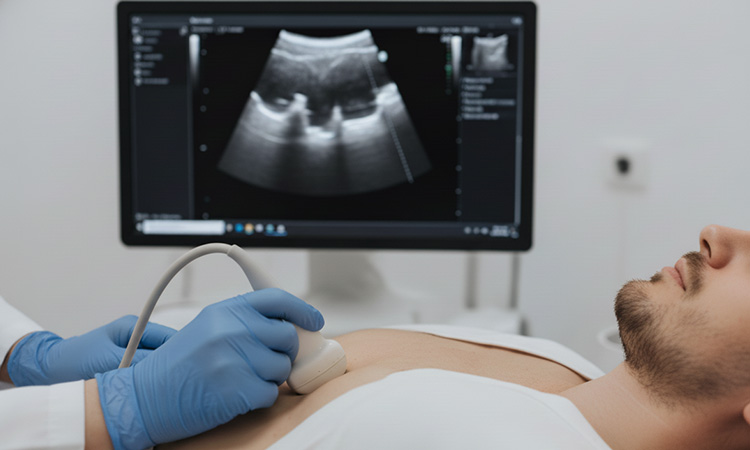
2D Echo Cardiography
Two-Dimensional Echocardiography (2D Echo) is a non-invasive ultrasound test that creates real-time, moving images of the heart. It uses high-frequency sound waves to produce a two-dimensional cross-section of the heart’s structures.
What 2D Echo Shows
- Size and shape of the heart chambers
- Movement and thickness of the heart walls
- Function of the heart valves
- Pumping ability (how well the heart contracts)
- Blood flow patterns (when combined with Doppler)
- Presence of clots, fluid around the heart, or structural abnormalities
Why It’s Done
Doctors commonly use 2D echo to diagnose or monitor:
- Heart failure
- Valve diseases (like stenosis or regurgitation)
- Congenital heart defects
- Cardiomyopathies
- Effects of a heart attack
- Pericardial effusion (fluid around the heart)
How the Test Works
- A handheld probe (transducer) is placed on the chest.
- Gel helps transmit ultrasound waves.
- The machine converts returning echoes into live images on the screen.
Is It Safe?
Yes, it’s painless, non-invasive, and does not use radiation.