
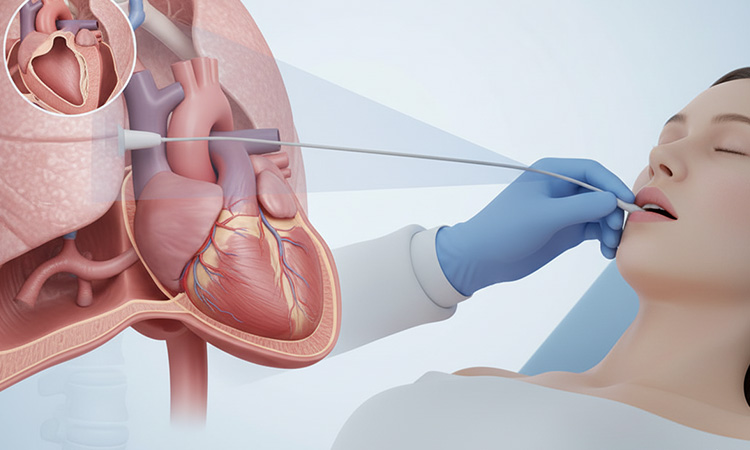
Trans Esophageal Echo (TEE)
Transoesophageal Echocardiogram (TOE or TEE) is a specialized ultrasound test that provides detailed images of the heart by placing an ultrasound probe in the oesophagus (food pipe), which lies directly behind the heart. This close proximity allows clearer and more accurate visualization than a standard transthoracic echo (TTE).
Below is a clear and structured explanation:
1. What is TEE?
TEE is an advanced ultrasound procedure where a flexible probe with an ultrasound transducer at its tip is passed through the mouth into the oesophagus to obtain high-resolution images of the heart and major blood vessels.
2. Why is TEE Done? (Indications)
Structural abnormalities
- Detecting atrial septal defects (ASD) and patent foramen ovale (PFO)
- Evaluating ventricular septal defects (VSD)
- Diagnosing valvular diseases (mitral, aortic, tricuspid)
Clot or mass detection
- Left atrial appendage thrombus (especially in atrial fibrillation)
- Cardiac tumors or vegetations
Infections
- Suspected infective endocarditis
Pre-procedural & intra-procedural guidance
- Guidance during device closures (ASD/PFO/VSD)
- Guidance during cardioversion when clot is suspected
- During valve repair/replacement surgeries
- Assessing prosthetic valve function
Other uses
- Aortic pathology (aneurysm, dissection)
- Source of embolism evaluation after stroke
3. How the Procedure is Performed
i. Preparation
- Fasting 6 hours
- Remove dentures
- IV line placed
ii. Anaesthesia
- Local throat numbing spray
- Sedation or general anaesthesia (varies by centre)
iii. Probe insertion
- Patient lies on left side
- Probe advanced gently into the oesophagus
iv. Image acquisition
- Images taken at multiple levels: upper, mid, lower oesophagus; gastric views
- Entire procedure typically 15–30 minutes
v. Recovery
- Observation until sedation wears off
- Avoid eating/drinking for 1–2 hours until gag reflex returns
4. What TEE Shows Better Than TTE
- Atrial septum (ASD/PFO)
- Mitral valve anatomy & regurgitation mechanisms
- Left atrial appendage
- Prosthetic valves
- Aorta (ascending, arch, descending)
- Small clots, vegetations, masses
5. Risks and Complications (generally low)
- Sore throat (common)
- Nausea or vomiting
- Minor bleeding
- Oesophageal irritation
- Very rare: perforation, aspiration, arrhythmias
TEE is considered very safe when performed by trained specialists.
6. Advantages
- High-resolution images
- Better visualization than transthoracic echo
- Essential for structural heart interventions
- No radiation exposure