
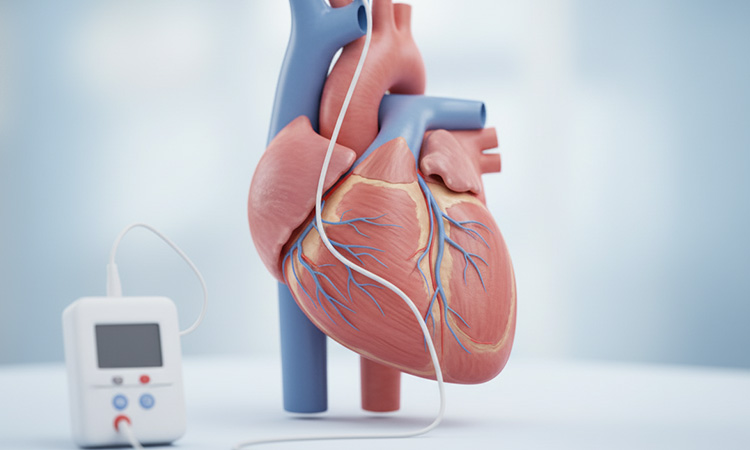
Temporary Pacemaker Implantation (TPI)
Temporary Pacemaker Implantation (TPI) is a short-term procedure used to support the heart’s rhythm during emergencies or when the heart rate becomes dangerously slow due to a reversible condition.
It is often used until the underlying problem is treated or until a permanent pacemaker can be implanted.
⭐ What Is a Temporary Pacemaker?
A temporary pacemaker uses an external pulse generator connected to one or more leads placed inside the heart.
It provides electrical impulses to maintain an adequate heart rate.
It is not implanted under the skin—the generator remains outside the body.
⭐ When Is a Temporary Pacemaker Needed?
Used in emergency or short-term situations such as:
1. Severe Bradycardia (very slow heart rate)
- Symptomatic sinus node dysfunction
- High-degree AV block (Mobitz II, complete heart block)
2. Reversible Conditions
- Drug overdose (beta blockers, calcium channel blockers)
- Acute myocardial infarction (heart attack) with conduction block
- Electrolyte imbalance (e.g., high potassium)
3. Before or During Procedures
- During cardiac surgeries
- During coronary angioplasty in high-risk patients
4. While Waiting for a Permanent Pacemaker
- If immediate pacing support is required
⭐ How the Procedure Is Done
1. Patient is monitored in an ICU/critical care setting.
2. A special pacing lead is inserted through a large vein:
- Internal jugular vein
- Femoral vein
- Subclavian vein
3. Under fluoroscopy or bedside guidance, the lead is positioned in the right ventricle.
4. Lead is connected to an external pacemaker box (pulse generator).
5. Settings such as pacing rate and output are adjusted.
Procedure time: Usually 15–30 minutes.
⭐ Types of Temporary Pacemakers
1. Transvenous (most common)
2. Transcutaneous (external pads on chest; emergency use only)
3. Epicardial (after heart surgery)
⭐ Benefits
- Provides immediate support to maintain heart rate
- Stabilizes the patient in critical conditions
- Buys time until a permanent solution is possible
- Can be life-saving in emergencies
⭐ Risks
- Infection
- Bleeding at the insertion site
- Lead displacement
- Arrhythmias
- Vein injury
- Rare: cardiac perforation
These are minimized by ICU monitoring.
⭐ Care After Temporary Pacemaker Placement
- Strict bed rest to avoid lead displacement
- Continuous ECG monitoring
- Regular checking of pacing thresholds
- Prevent infection at the insertion site